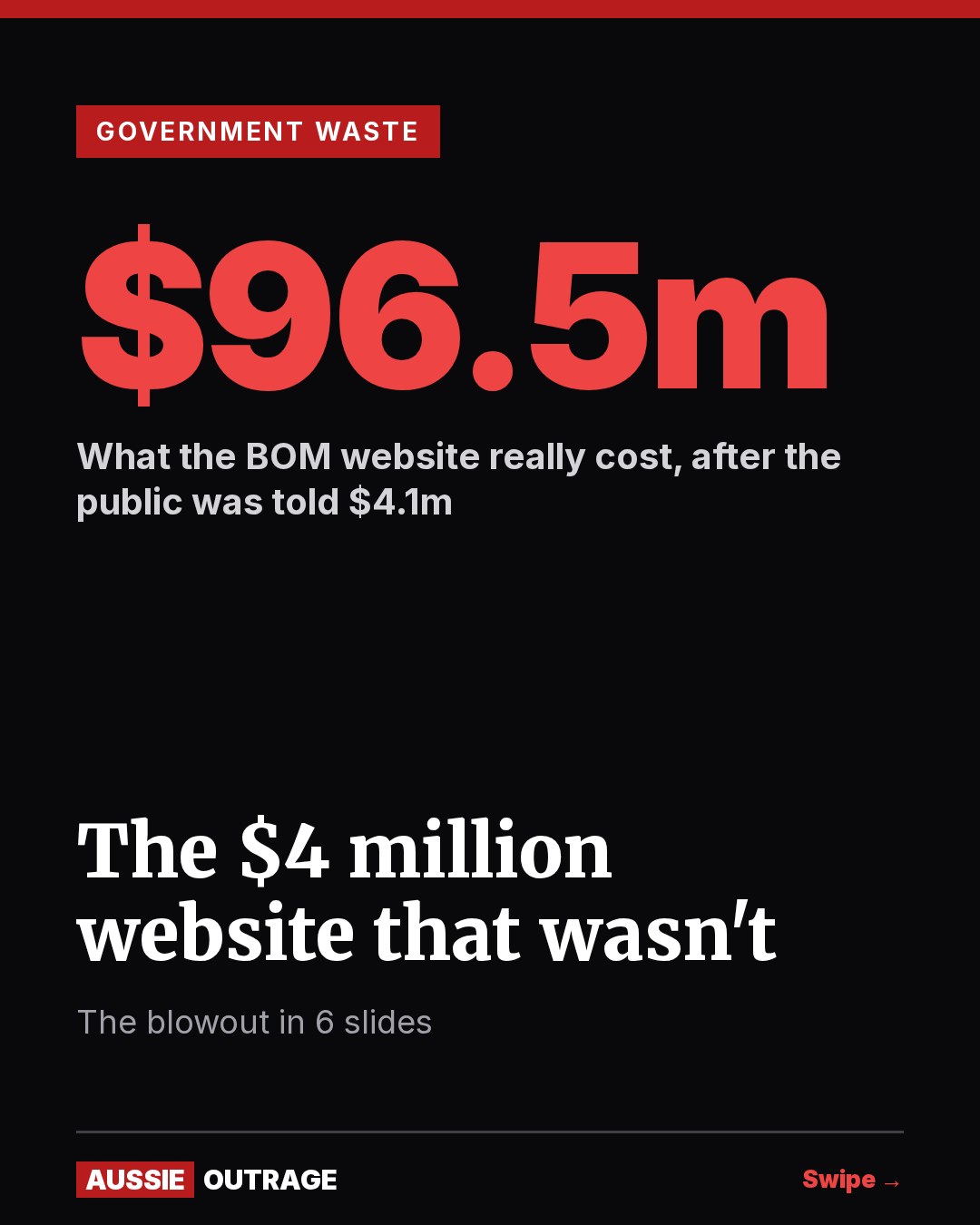
$96.5m
What the BOM website really cost, after the public was told $4.1m
One year on: the BOM website that cost $96.5 million, not $4 million
The weather bureau's redesign launched days before a wild storm weekend, confused farmers, and cost 23 times what Australians were first told. Then the same contractor won more work.
Aussie Outrage · · 6 min read
Updated 30 October 2026
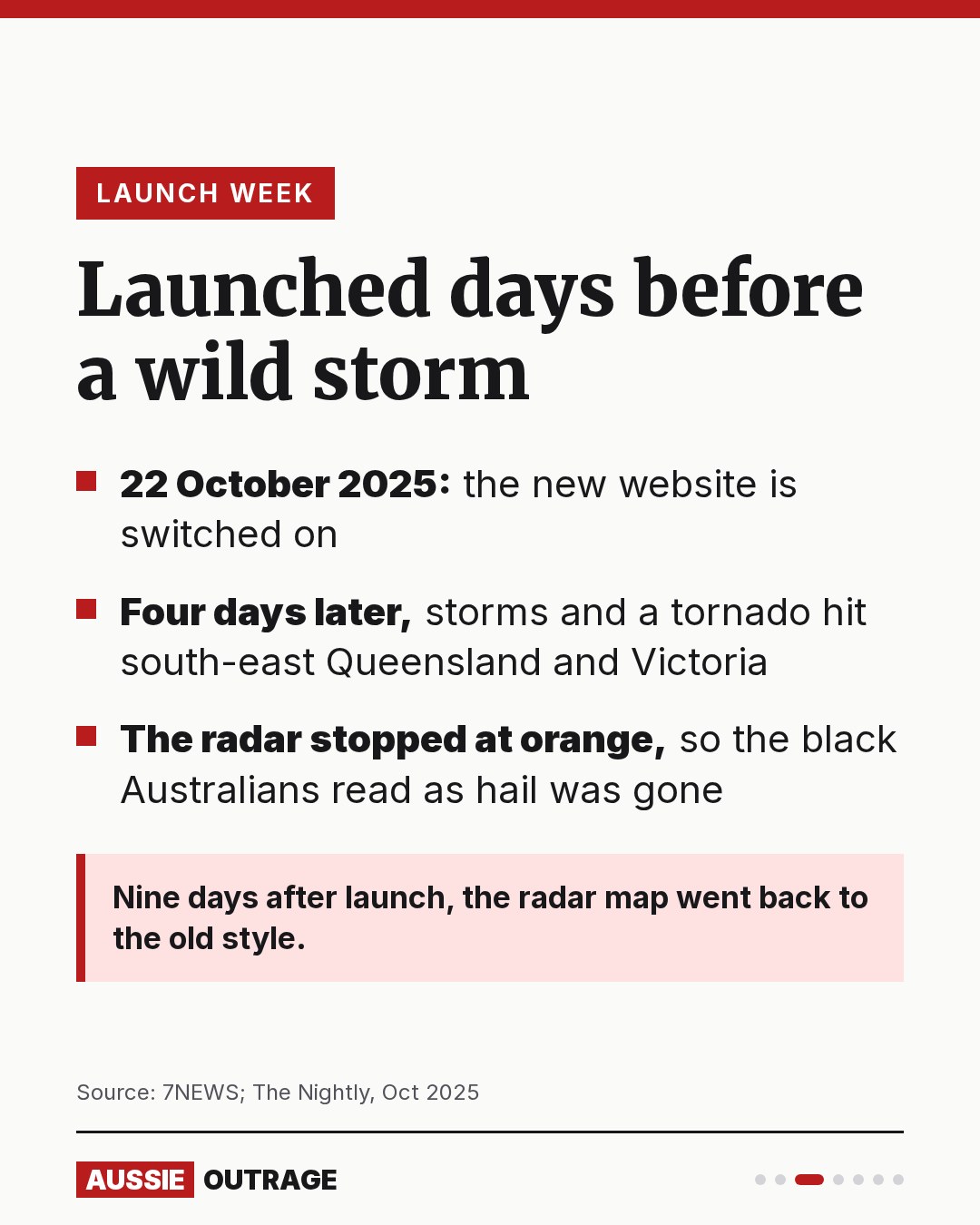
On Wednesday 22 October 2025, the Bureau of Meteorology switched on its new website. Four days later, on Sunday afternoon, severe thunderstorms and a tornado tore across south-east Queensland and Victoria, leaving more than 60,000 Queensland homes without power. It was exactly when millions of people needed the radar most.
What they got was a radar that was hard to read, place names they couldn't make out, and rainfall data that farmers couldn't find. The new radar's colour scale stopped at orange, so the black that Australians had learned to read as hail was gone. "The new BOM radar view has essentially clipped the top end of the radar scale at orange, so we can't see any detail in the biggest storms," 7NEWS meteorologist Tony Auden said. Nationals leader David Littleproud pointed out you could no longer search by GPS coordinates, only by town or postcode, which is useless if your property sits between towns.
Nine days after launch, the bureau switched the radar map back to the old style.
The $4 million website that wasn't
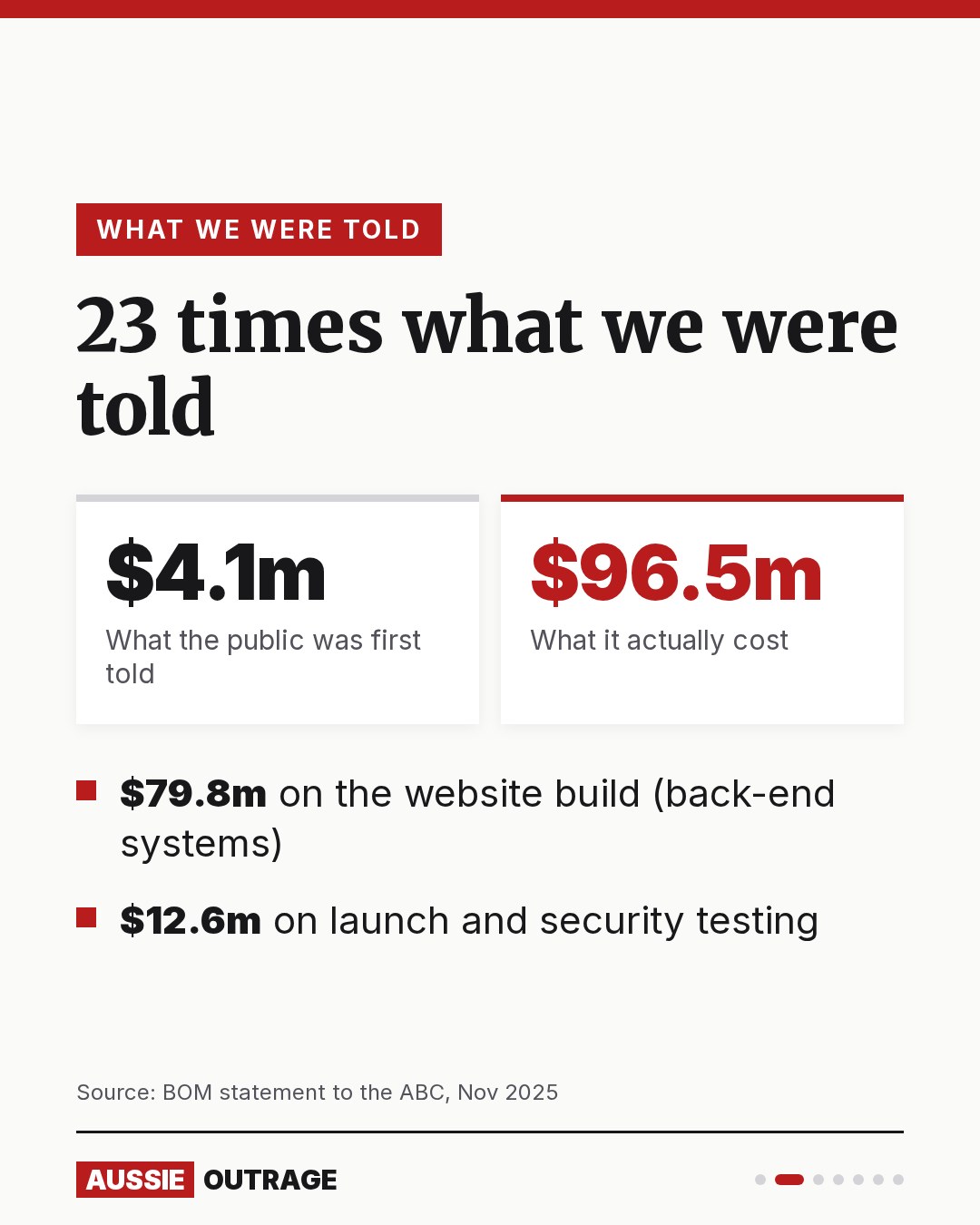
At first, the public was told the redesign cost about $4.1 million. A month after launch, the bureau told the ABC the real figure was approximately $96.5 million.
23x
What we were told vs what it cost
Cost of the BOM website, millions of dollars
What the public was first told
$4.1mWhat it actually cost
$96.5m
Source: BOM statement to the ABC, November 2025
Show the data
| Item | Value |
|---|---|
| What the public was first told | $4.1m |
| What it actually cost | $96.5m |
| What | Cost |
|---|---|
| Redesign | $4.1m |
| Website build (back-end systems) | $79.8m |
| Launch and security testing | $12.6m |
| Total | ~$96.5m |
A $31 million contract that became $78 million
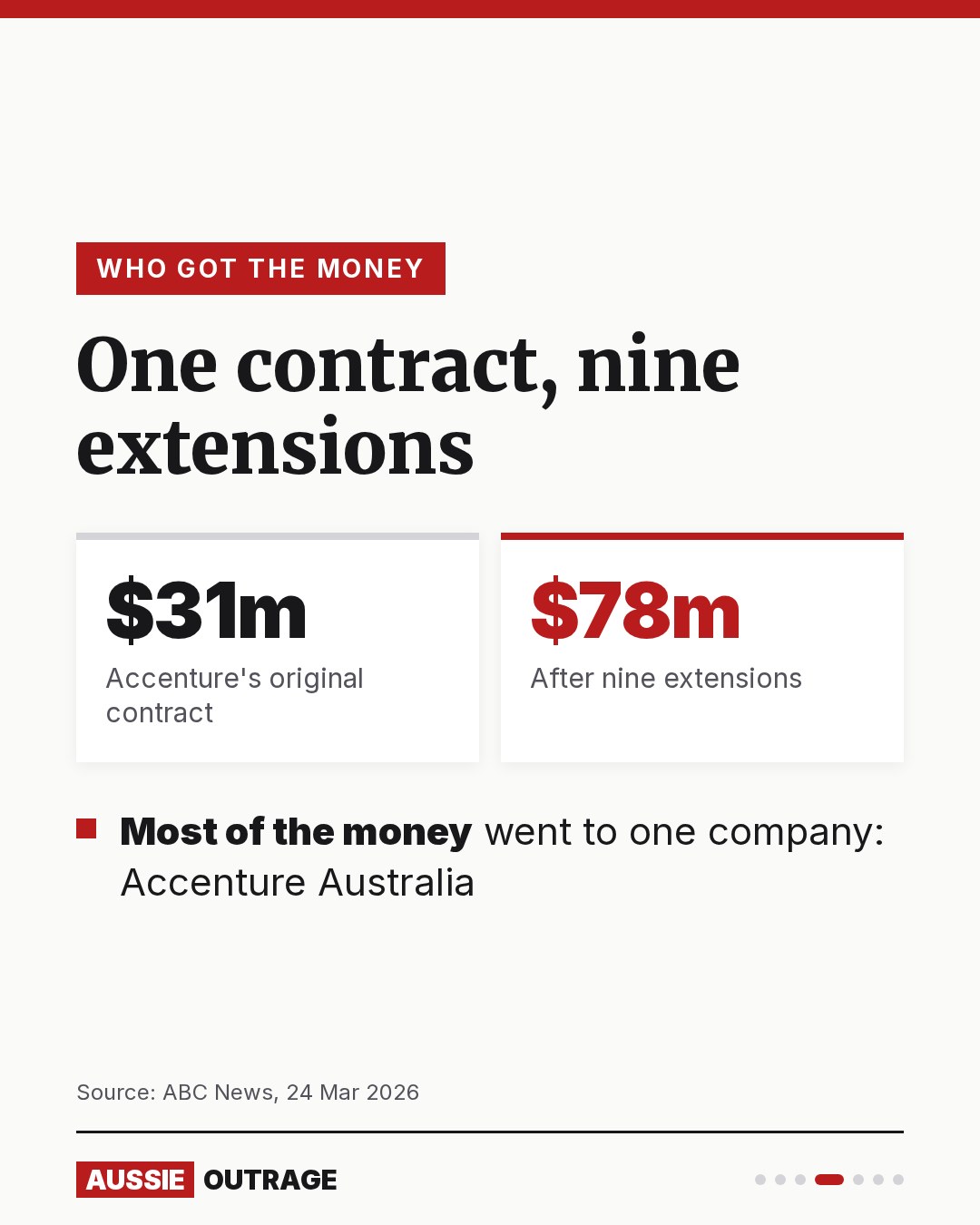
Most of the money went to one company. The bureau's contract with Accenture Australia started at $31 million and grew to $78 million through nine extensions.
Accenture's contract, before and after nine extensions
Value of the BOM contract, millions of dollars
Original contract
$31mAfter nine extensions
$78m
Source: ABC News, 24 March 2026
Show the data
| Item | Value |
|---|---|
| Original contract | $31m |
| After nine extensions | $78m |
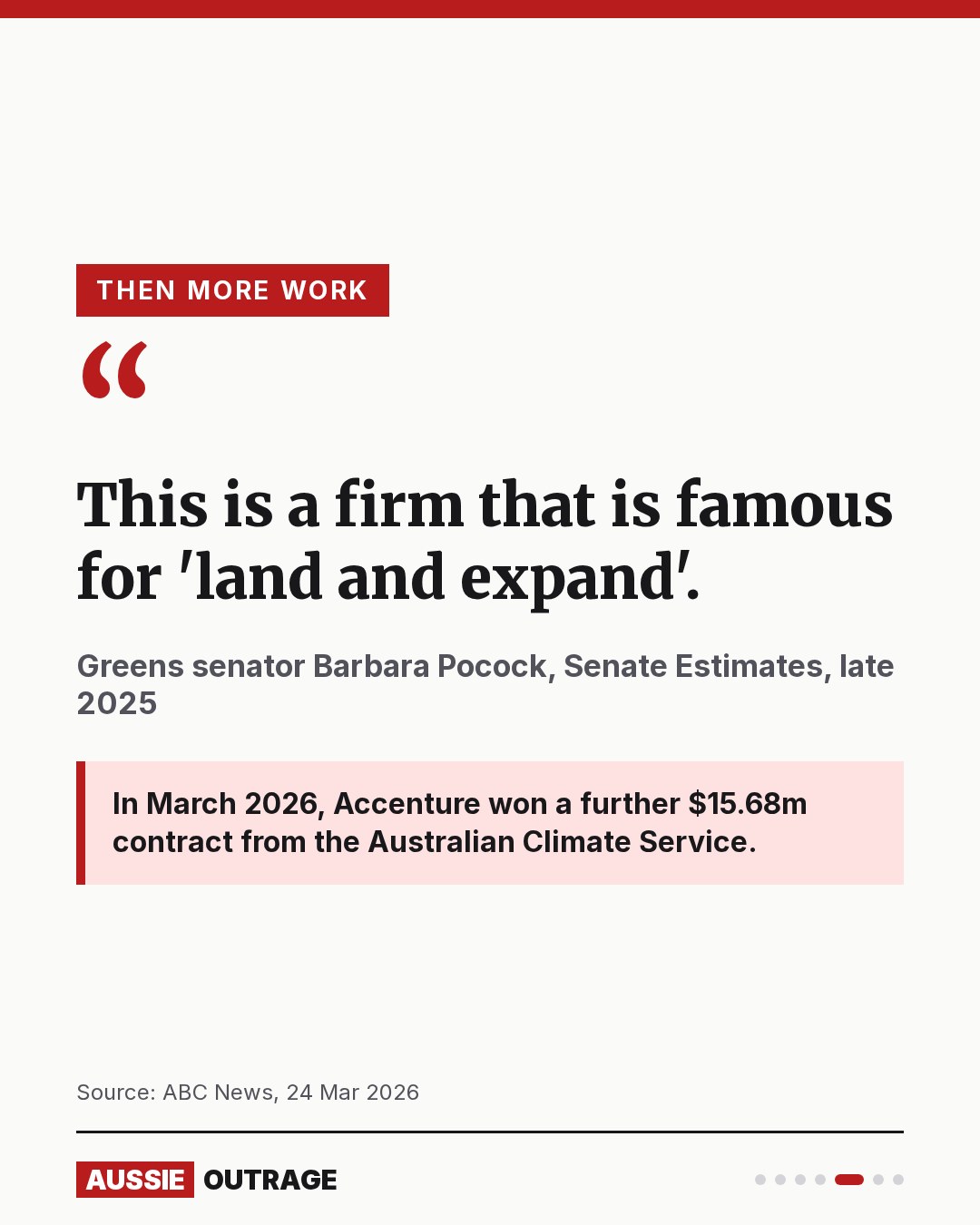
At Senate Estimates in late 2025, Greens senator Barbara Pocock called it a "nightmare Harvard case study in contract failure and management of contracts", and said of Accenture: "This is a firm that is famous for 'land and expand'." The bureau's chief information and technology officer, Nichole Brinsmead, pushed back: "I don't think these contracts were as badly managed as you make out." Environment Minister Murray Watt said it "may well be a contract that demonstrates the need for greater oversight of consultants".
The website is part of a much bigger overhaul known as the ROBUST program, set up after a significant cyber intrusion in 2015 and major technology outages in 2016. ROBUST was funded in three tranches in the 2017-18, 2018-19 and 2020-21 Budgets ($91.5 million, $346.9 million and $350 million), a total of $788 million. According to the bureau's chief executive, it closed in July 2024 having cost $866 million, with the extra $78 million coming from the bureau's own budget, and a follow-up "transition program" to finish the remaining work cost another $47 million. The new website "accounted for approximately $96 million" of ROBUST.
Minchin told Senate Estimates the response to the launch "shows that we didn't get it right for some sectors of the community".
Then the same company won more work
In March 2026, the Australian Climate Service (a partnership of federal agencies that includes the bureau) awarded Accenture a further $15.68 million contract to build a "Climate Risk Hub", with options that could run to 2033. Climate scientists, speaking anonymously to the ABC, questioned whether it would deliver value for money, especially if it came at the expense of research at the bureau and CSIRO.
Still waiting for answers
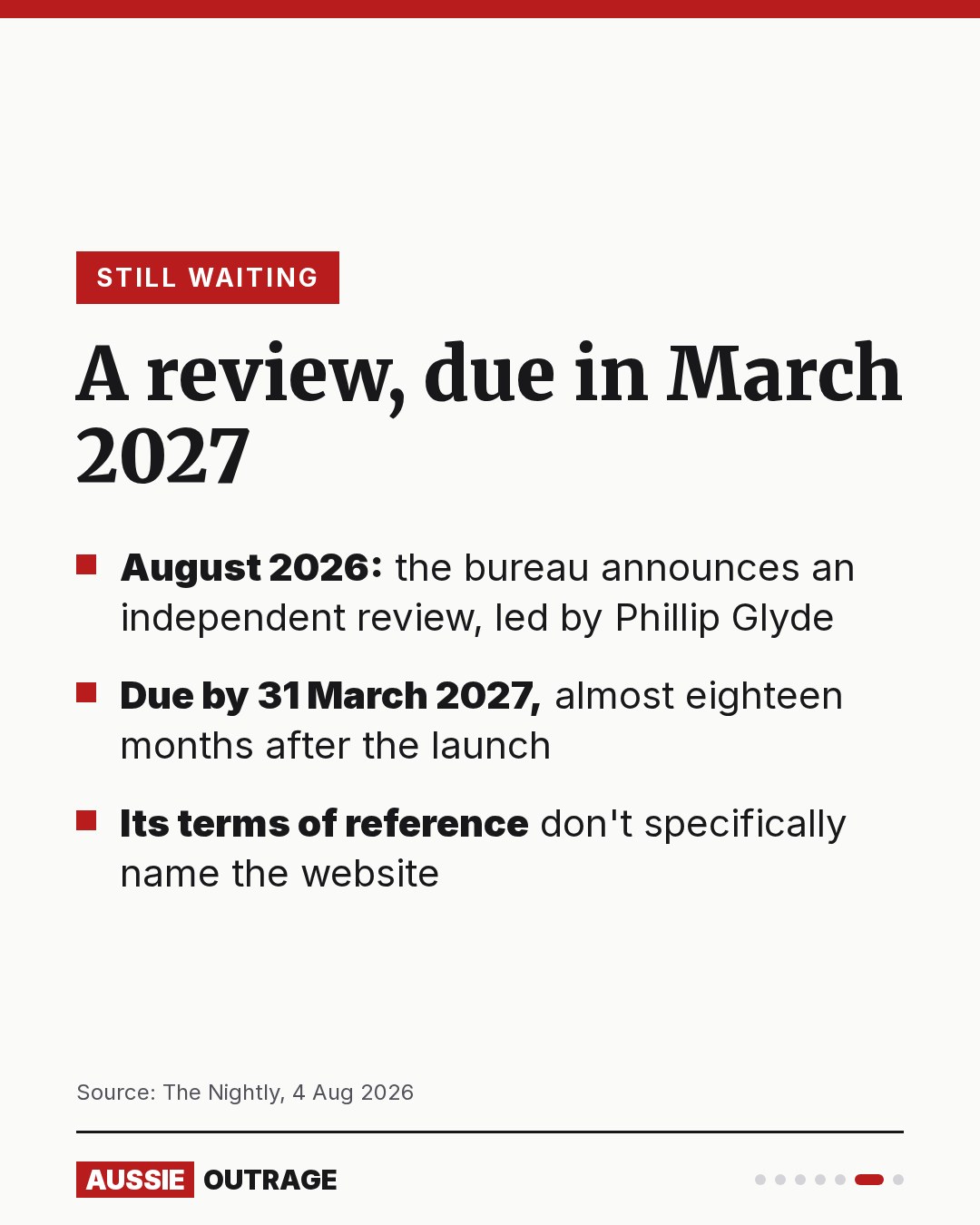
Watt asked the bureau's new chief executive, Stuart Minchin, to report back on what went wrong. In August 2026 the bureau announced an independent review led by Phillip Glyde, a former chief executive of the Murray-Darling Basin Authority. It is due to report by 31 March 2027, almost eighteen months after the launch, and its terms of reference don't specifically name the website.
Why it matters
The BOM website isn't a vanity project. Farmers plan harvests around it, emergency services use it in floods and fires, and families check it before they drive. When it fails during a storm, that isn't a design problem. It's a safety problem.
And when a public agency tells taxpayers a project cost $4 million, then admits it cost $96.5 million, people are entitled to ask what else they haven't been told.
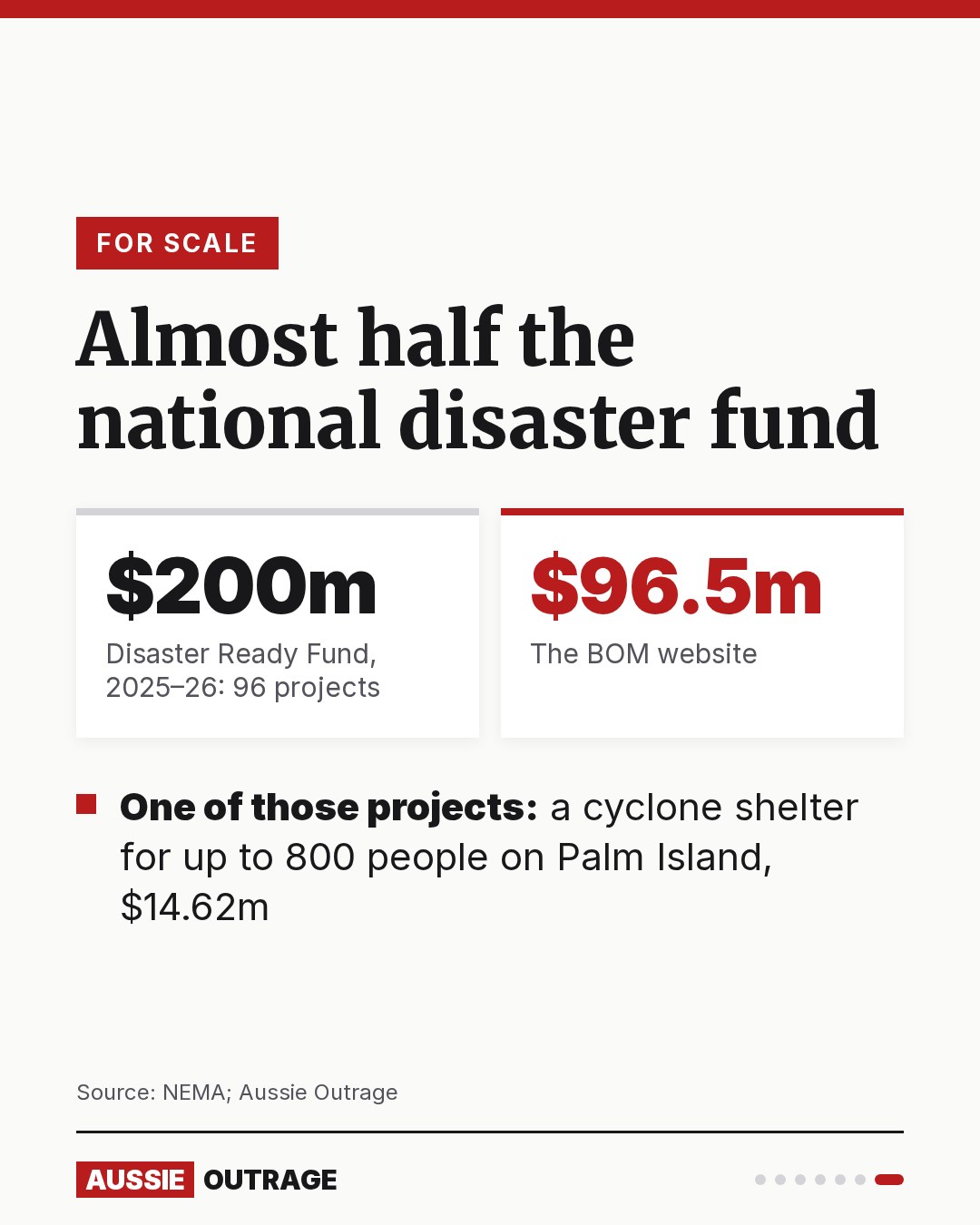
For scale: the BOM website cost almost half as much as a whole year of the federal government's Disaster Ready Fund. In 2025–26 the fund put $200 million into 96 projects across Australia to prepare for bushfires, floods and cyclones, according to the National Emergency Management Agency. One of them is a cyclone shelter for up to 800 people on Palm Island, with $14.62 million in Commonwealth funding.
One website vs a year of disaster readiness
Millions of dollars
Disaster Ready Fund, 2025–26 (96 projects)
$200mThe BOM website
$96.5m
Source: NEMA, Disaster Ready Fund Round Three (2025–26); BOM statement to the ABC, November 2025
Show the data
| Item | Value |
|---|---|
| Disaster Ready Fund, 2025–26 (96 projects) | $200m |
| The BOM website | $96.5m |
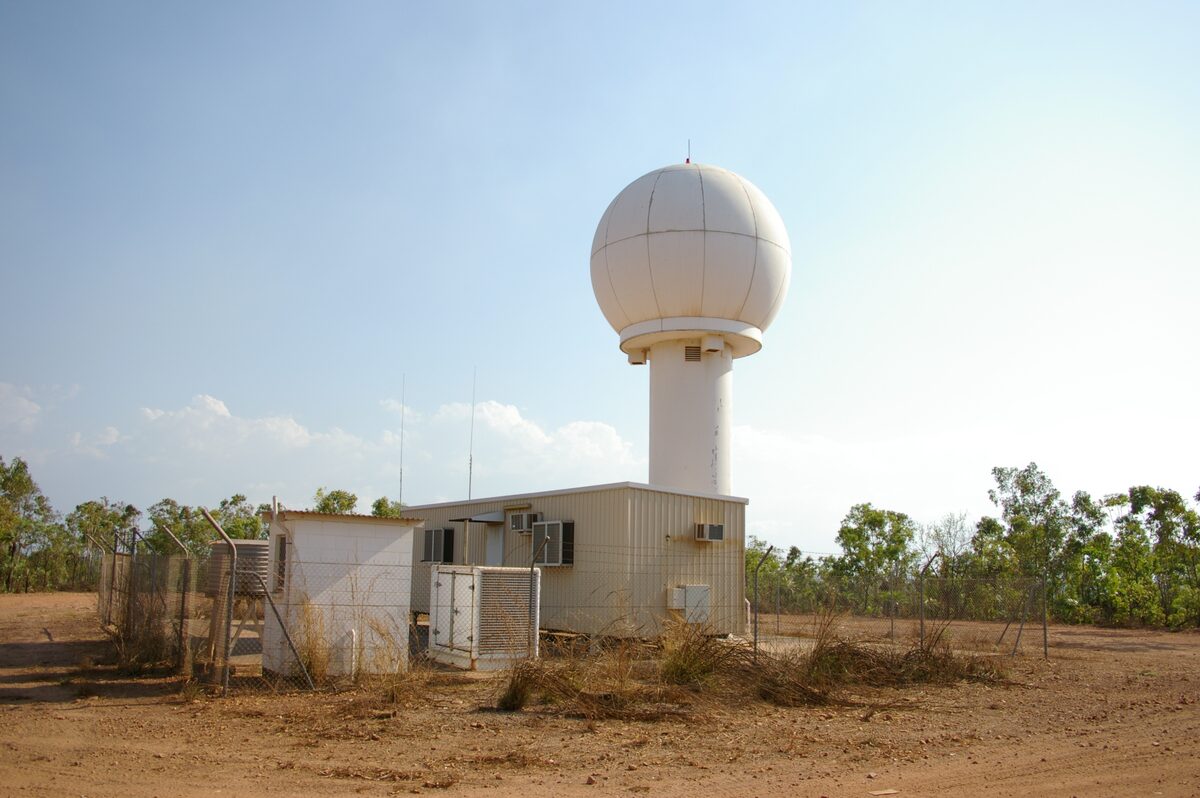
Top photo: the Bureau of Meteorology's Berrimah weather radar, Darwin (file photo, 2007). Photo: Bidgee, CC BY 3.0, via Wikimedia Commons.
Sources
- ABC News: BOM's new boss asked to examine $96.5m bill for website redesign (23 Nov 2025) (opens in a new tab)
- ABC News: Company that built highly criticised BOM website wins $16m contract (24 Mar 2026) (opens in a new tab)
- Information Age (ACS): Storm erupts over BOM's $96.5m website bill (opens in a new tab)
- Bureau of Meteorology: CEO opening statement to Senate Estimates (opens in a new tab)
- The Nightly: BOM to face independent review after $96m website launch (4 Aug 2026) (opens in a new tab)
- The Nightly / 7NEWS: New BOM radar caused confusion after storms rip through Queensland and Victoria (27 Oct 2025) (opens in a new tab)
- National Emergency Management Agency: Disaster Ready Fund (opens in a new tab)
Spotted an error, or named in this story and want to respond? Tell us. We correct mistakes openly, under our editorial standards.
Got a story we should tell?
Waste you've seen up close, a policy that's hurting your family, a cost you can't keep up with. We read every tip and protect our sources.
Send us a tipMore in Government Waste
Suburban Rail Loop cost: $50bn promised, $96.4bn forecast
How much will the Suburban Rail Loop cost? $33.3bn for stage one, says the government, but the Auditor-General says it could top $36bn. Two stages: $96.4bn.
Aussie Outrage · · 12 min read

$1.6 million on pot plants for Big Build offices
Rail Projects Victoria spent an estimated $1.64 million on plant hire and maintenance, and the Suburban Rail Loop Authority almost $200,000 more, according to the state opposition.
Aussie Outrage · · 2 min read
$589 million to host nothing: what cancelling the Commonwealth Games cost Victoria
Victoria pulled out of the 2026 Commonwealth Games to save money. The Auditor-General found walking away cost $589 million with no discernible benefit, and the $6.9 billion figure used to justify it was overstated.
Aussie Outrage · · 2 min read

The $13 million machete ban: what the money actually pays for
Victoria set aside $13 million for its machete ban and amnesty bins. The bins cost about $2,400 each. The government still hasn't said where the rest of the money goes.
Aussie Outrage · · 2 min read