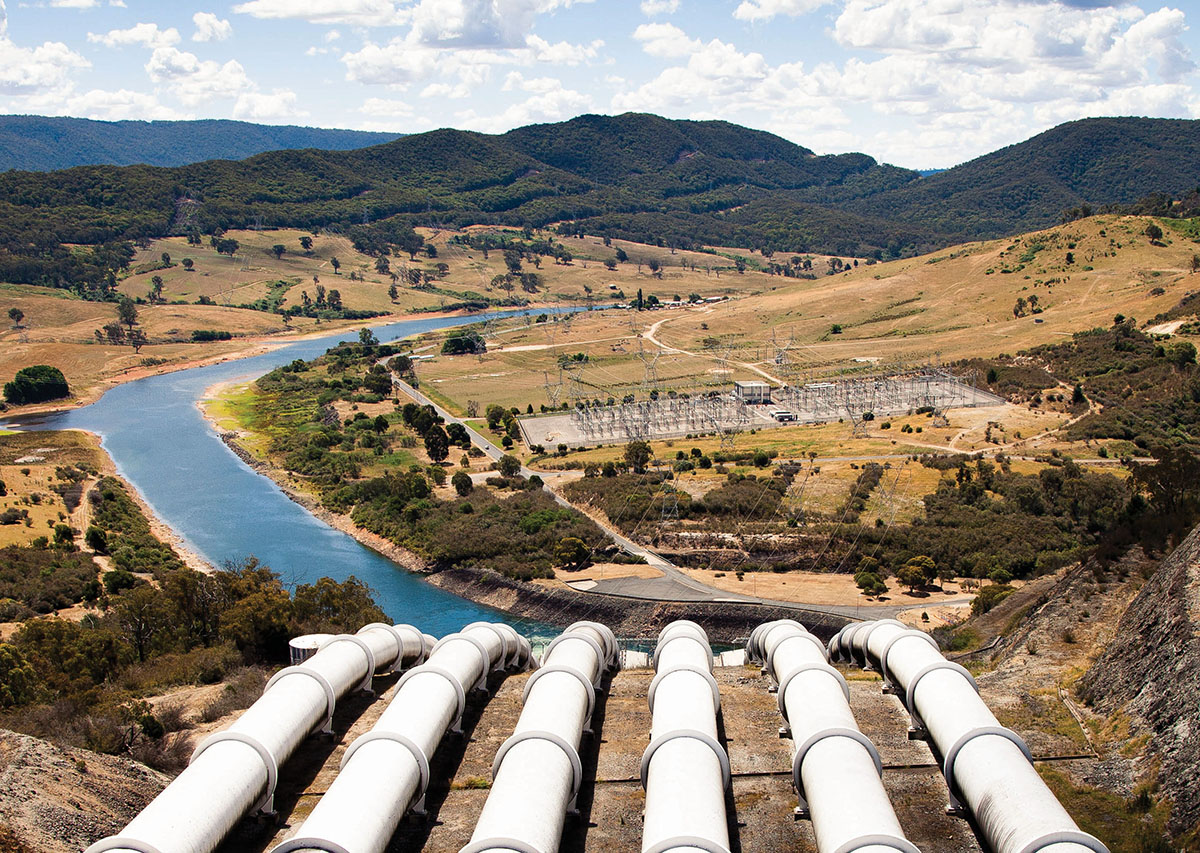
12x
Snowy 2.0's possible final cost compared with the 2017 price tag
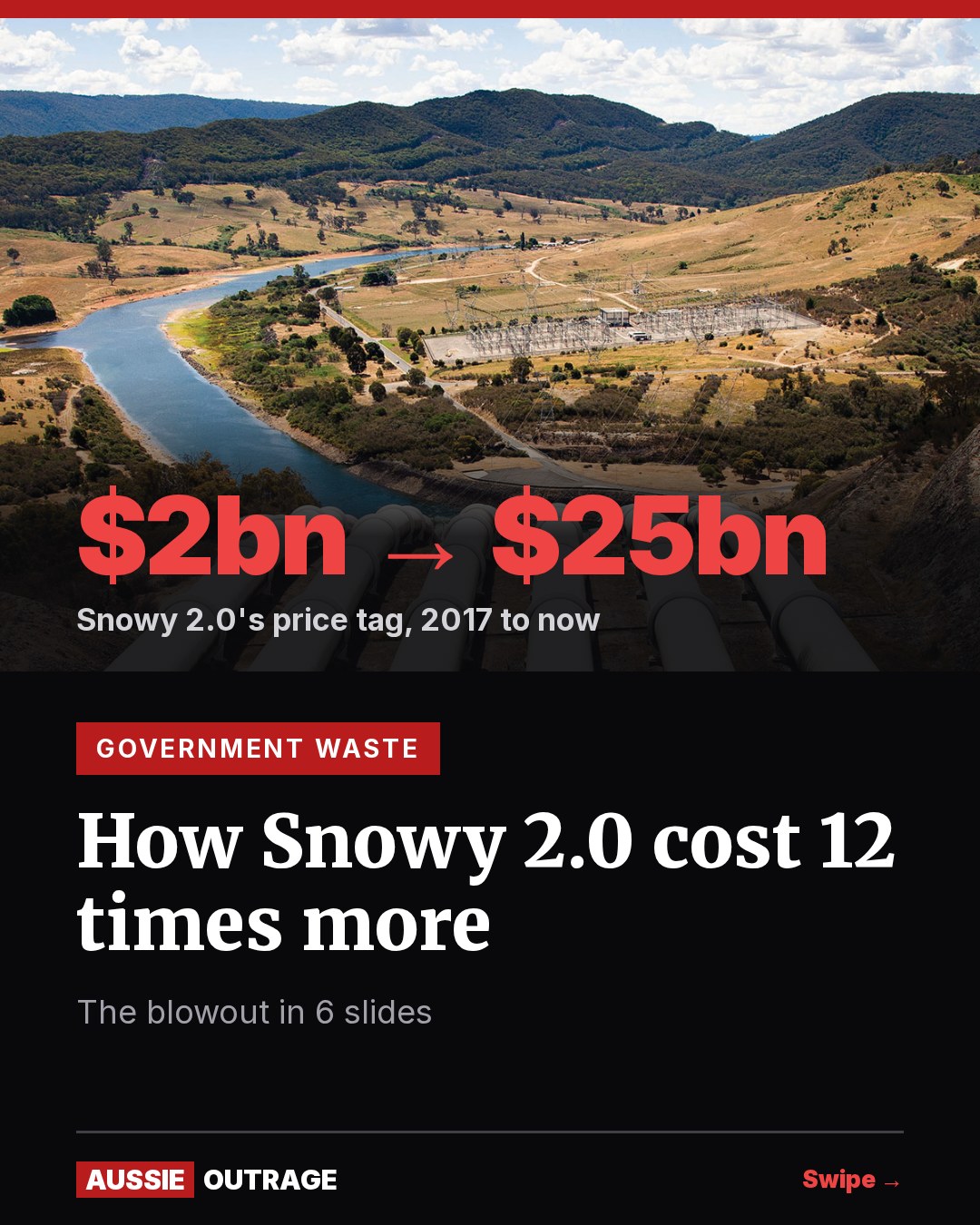
Snowy 2.0 was sold as a $2 billion project. It could now cost $25 billion
Snowy 2.0 was sold at $2 billion in 2017. Snowy Hydro's new target cost is $22.2 billion, up to $25 billion, and first power is now 2029. How it blew out.
Aussie Outrage · · 9 min read
Updated 27 October 2026
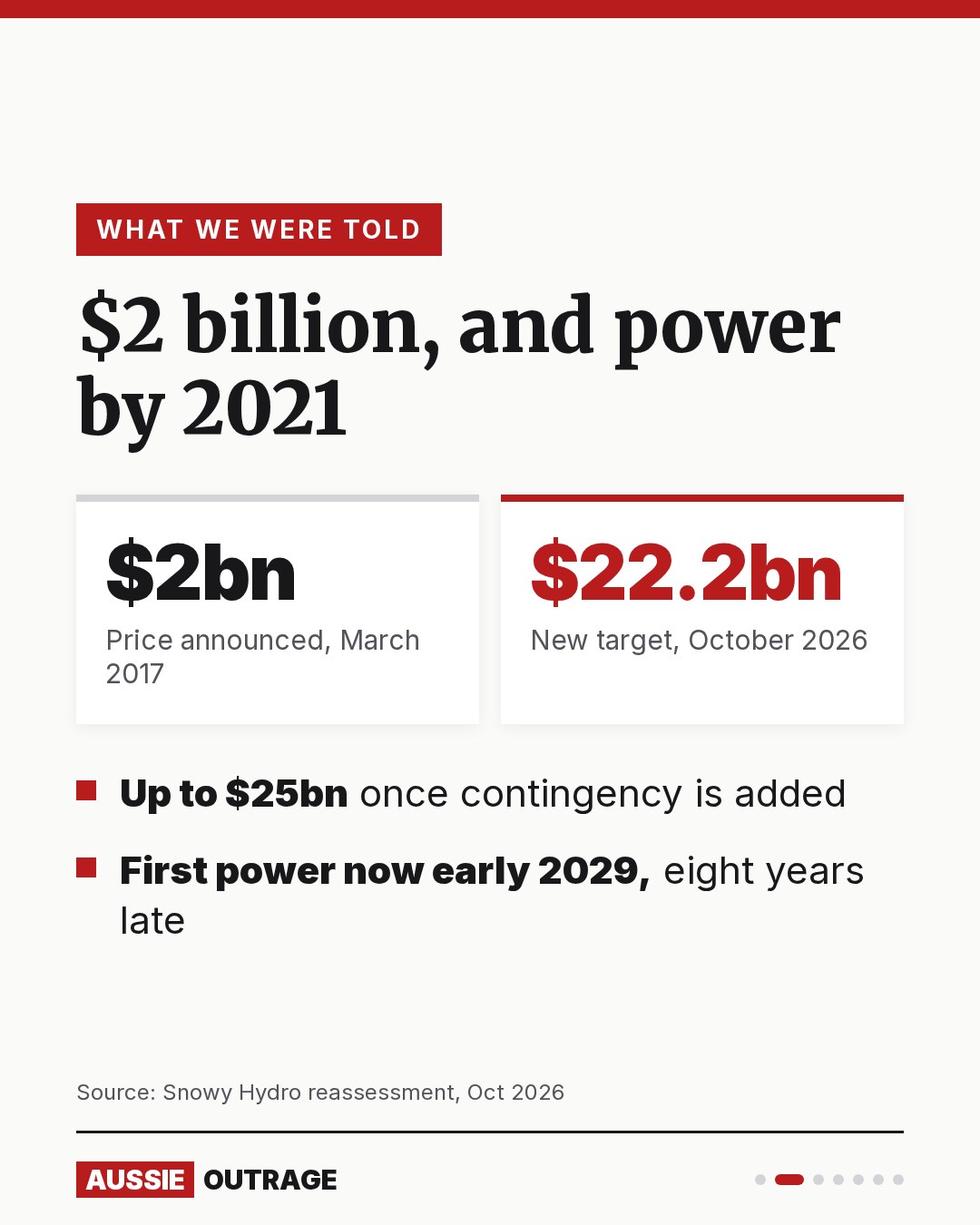
Snowy 2.0 began in March 2017, when Prime Minister Malcolm Turnbull announced a nation-building idea: expand the Snowy Mountains Scheme into a giant "battery" that pumps water uphill when power is cheap and releases it when power is scarce. The cost was about $2 billion, and power was promised by 2021.
On 22 October 2026, Snowy Hydro released its latest reassessment. The new target is $22.2 billion, with a contingency that could take the total to $25 billion. First power has moved to early 2029, with full operation later that year.
$25bn
The price tag, year by year
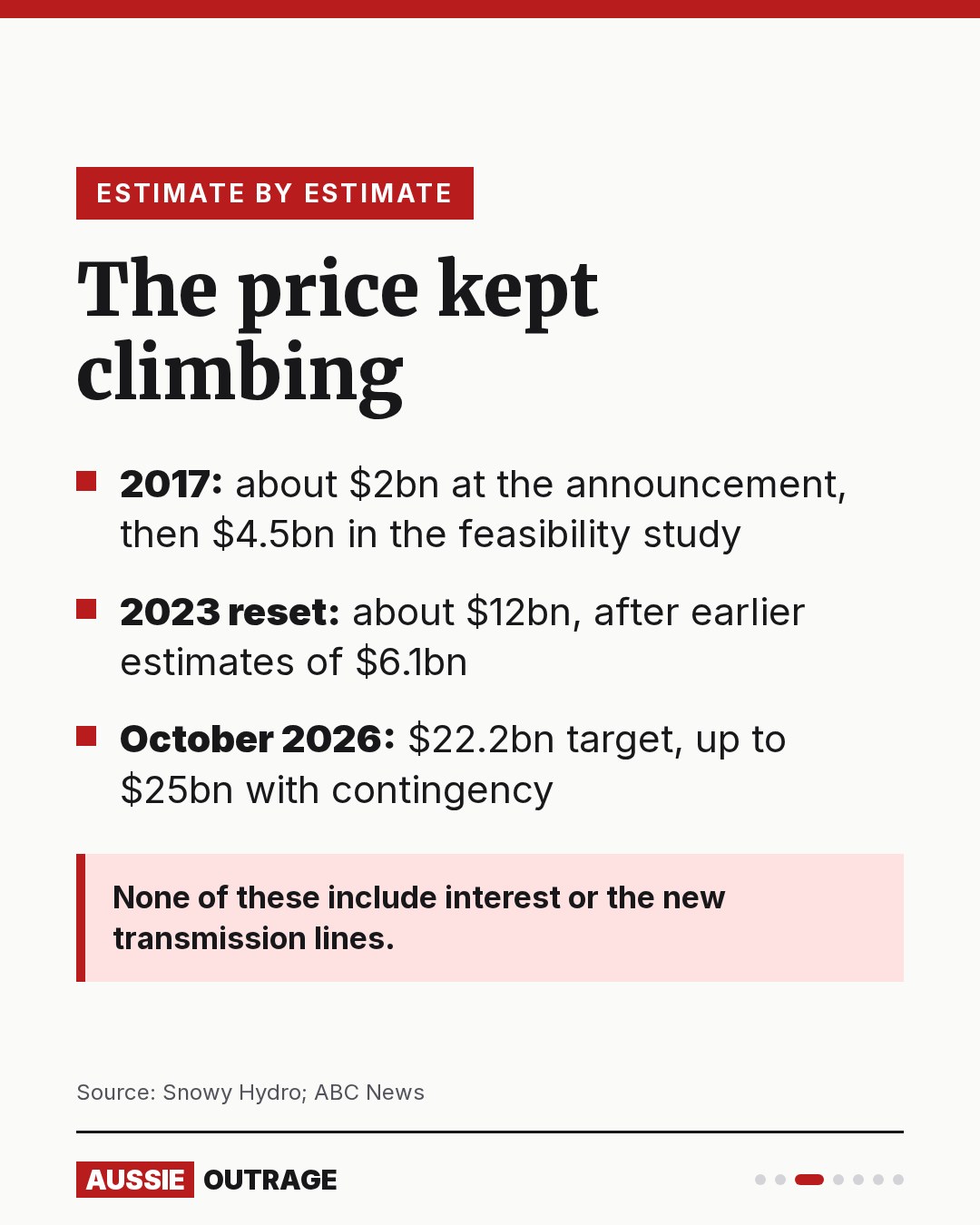
Snowy 2.0's price tag, estimate by estimate
Official cost estimates, billions of dollars
October 2026 shows the $22.2bn target. Snowy Hydro says contingency could take it to $25bn. Transmission lines are not included.
Source: Snowy Hydro; ABC News (3 Jun and 22 Oct 2026); Construction Briefing
Show the data
| Date | Value |
|---|---|
| Mar 2017 | $2bn |
| Dec 2017 | $4.5bn |
| Aug 2023 | $12bn |
| Oct 2026 | $22.2bn |
| When | Estimated cost | Promised completion |
|---|---|---|
| March 2017 (announcement) | ~$2bn | 2021 |
| December 2017 (feasibility study) | $4.5bn | |
| Before the 2023 reset | $6.1bn | May 2026 |
| August 2023 (project reset) | ~$12bn | December 2028 |
| October 2026 (reassessment) | $22.2bn, up to $25bn | Late 2029 |
That's a project that has become 11 to 12 times more expensive and is running eight years late. It isn't the only federal megaproject to blow out by billions: Inland Rail was sold as a $10.7 billion project and now costs $45.6 billion. See how they compare on our blowout leaderboard.
And Snowy 2.0's cost figures don't include the interest on the money borrowed, or the new transmission lines needed to connect it to the grid. Energy executive Ted Woodley and economist Bruce Mountain have estimated that adding interest and a share of the new transmission lines takes the cost to about $42 billion. Snowy Hydro called their figures unsubstantiated, and others dispute how much transmission should be counted. It is not an official figure, but it shows how much sits outside the headline number.
What went wrong
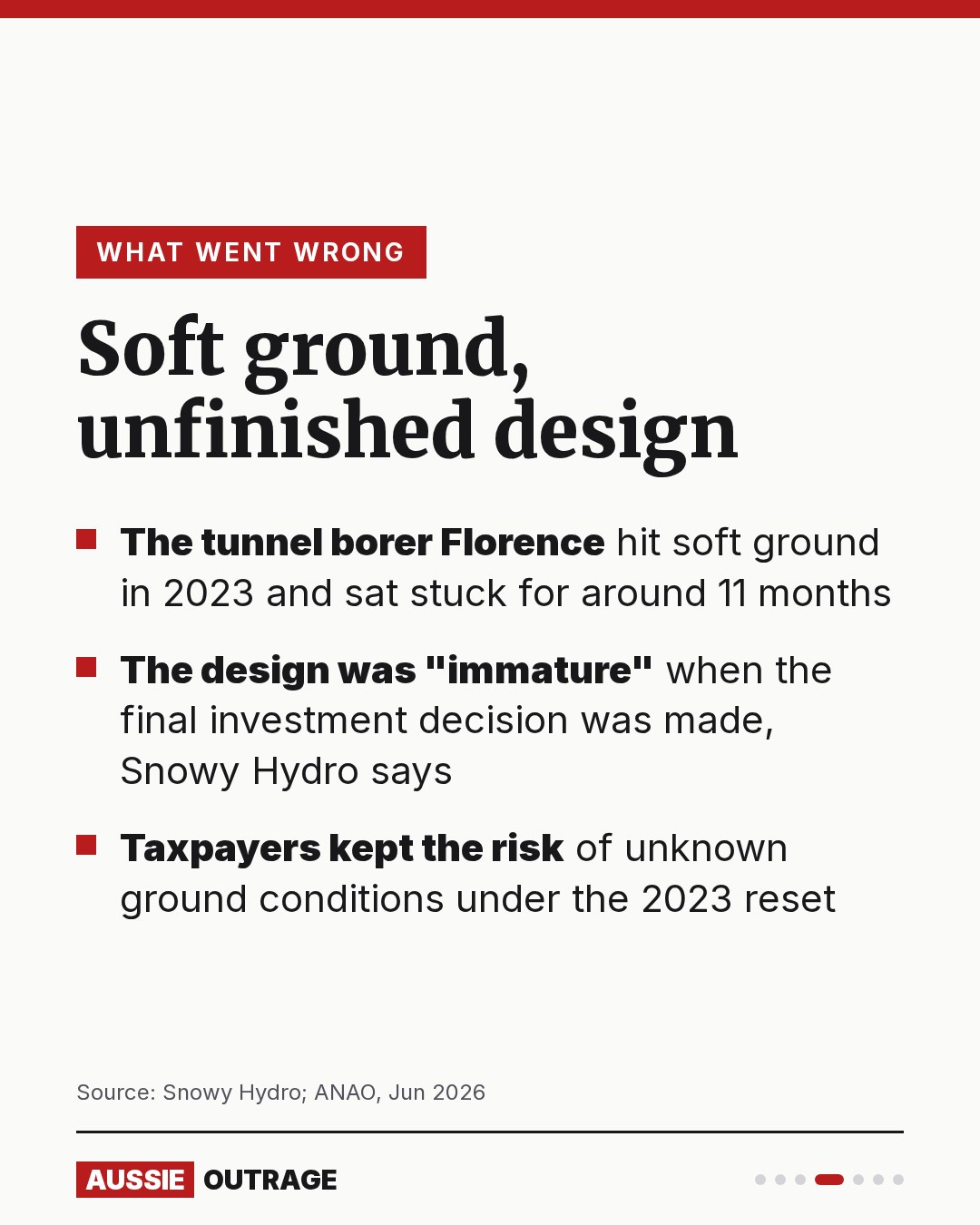
The ground fought back. In February 2023, the tunnel boring machine Florence hit soft ground 150 metres into a 15-kilometre tunnel, the ground above collapsed into a sinkhole, and the machine sat stuck for around 11 months. Under the 2023 reset, Snowy Hydro (and so taxpayers) kept the risk of unknown ground conditions, the ANAO found.
The design wasn't finished. Snowy Hydro's reassessment says "the design of the project was immature when the final investment for the project was made", and that its main contractor, the Future Generation Joint Venture (Webuild, Clough and Lane), "failed to meet productivity targets as a result of the construction complexities".
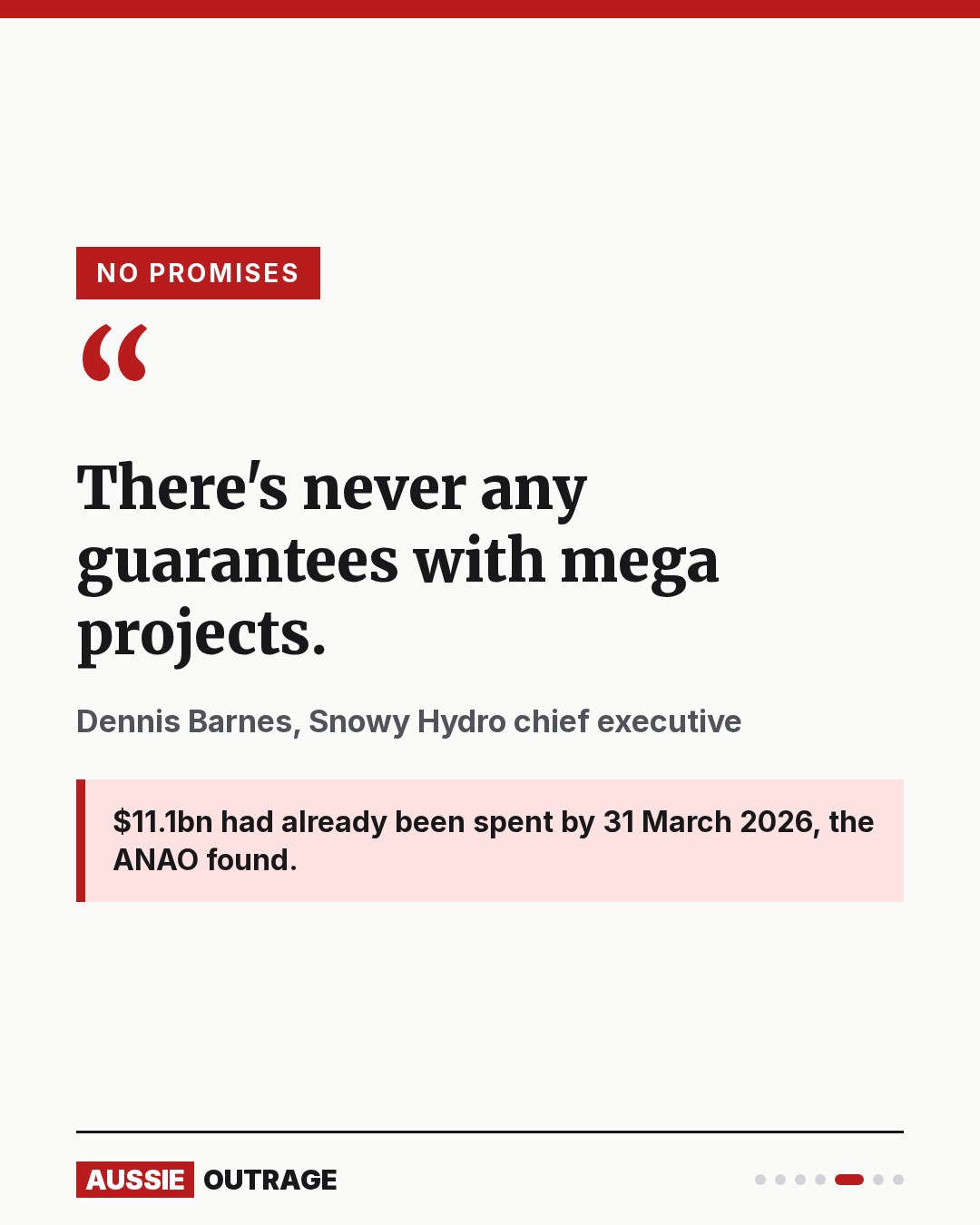
Nobody was holding the contractors to account. In June 2026 the Australian National Audit Office found Snowy Hydro's management of the project since the 2023 reset was only "partly effective". It found "significant deficiencies": there is no agreed baseline schedule, the incentive framework for contractors "is not working as intended", there are not enough controls over payments to secondary subcontractors, and Snowy Hydro "did not seek external verification of its own costs" before the reset. As of 31 March 2026, $11.1 billion had already been spent.
More people, for longer. About 5,000 people now work on the project, which Snowy Hydro chief executive Dennis Barnes said is "obviously a lot more than we thought in 2023".
How far along is Snowy 2.0?
Most of the digging is done. Snowy Hydro's October 2026 update compares progress now with the 2023 reset:
| Part of the project | At the 2023 reset | October 2026 |
|---|---|---|
| Drill-and-blast tunnels | 20% | 95% |
| Tunnels dug by boring machine | 19% | 65% |
| Excavation of the underground power station complex | 2% | 90% |
| Construction design | 44% | 96% |
More than 5,000 people are working on it. First power is expected in early 2029 and the new target completion date is late 2029. By 31 March 2026, $11.1 billion had already been spent, the ANAO found.
Bonuses anyway
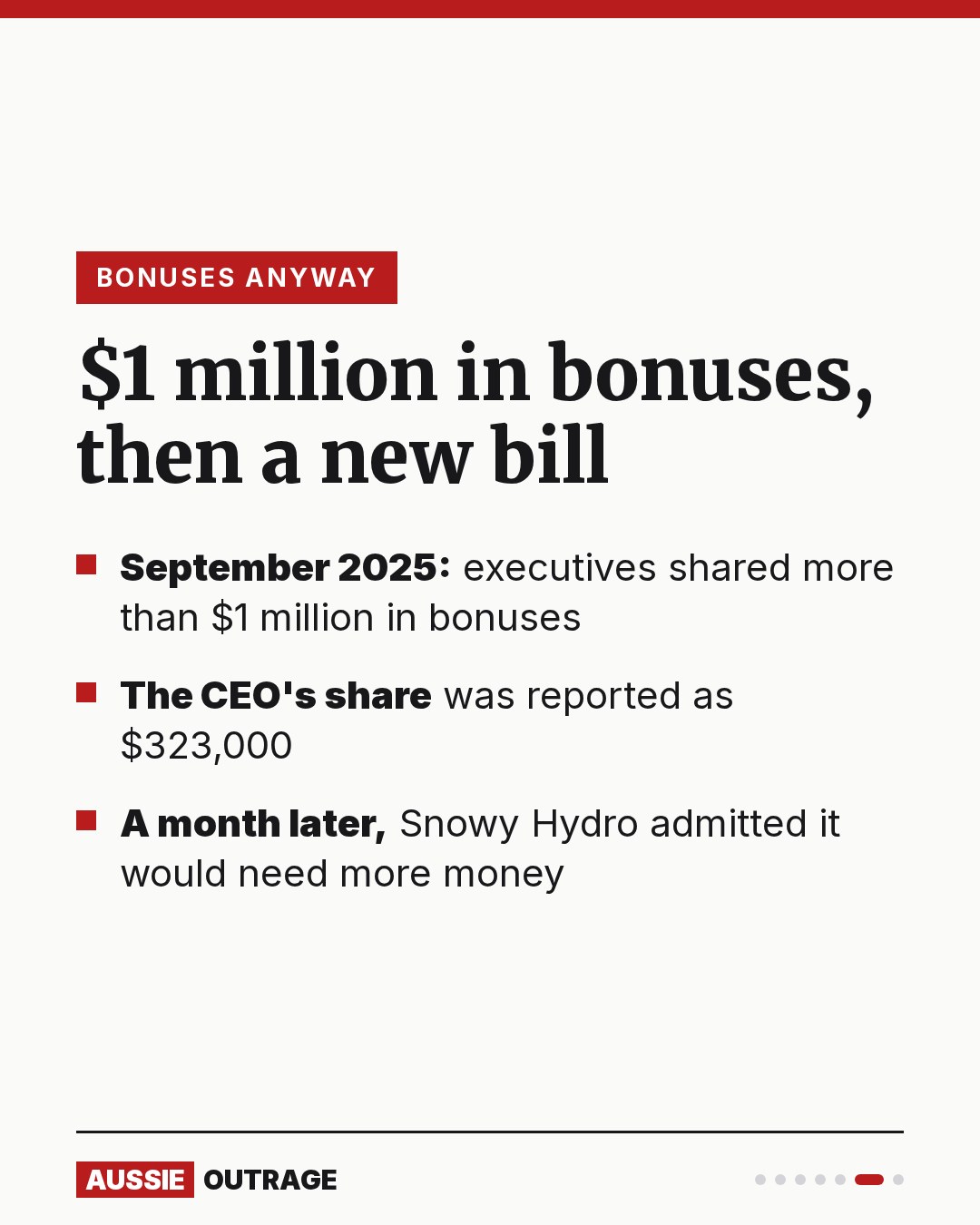
In September 2025, a month before Snowy Hydro admitted it would need more money, its executives shared more than $1 million in bonuses for meeting non-financial targets, despite missing financial ones. The chief executive's share was reported as $323,000.
Who pays for Snowy 2.0's cost blowout?
Snowy Hydro says "the $22.2 billion target cost is not the amount that will have to be funded by taxpayers". At the previous $12 billion estimate, it says, "around one-third or $4 billion, was Commonwealth investment in the company that Snowy Hydro did not need to repay". The majority was funded by government and bank loans that Snowy must repay with interest, and by Snowy's own cash flows.
How the extra $10.2 billion will be paid for hasn't been settled. "Work is underway on the Commonwealth's preferred capital strategy at the new cost," Snowy Hydro says.
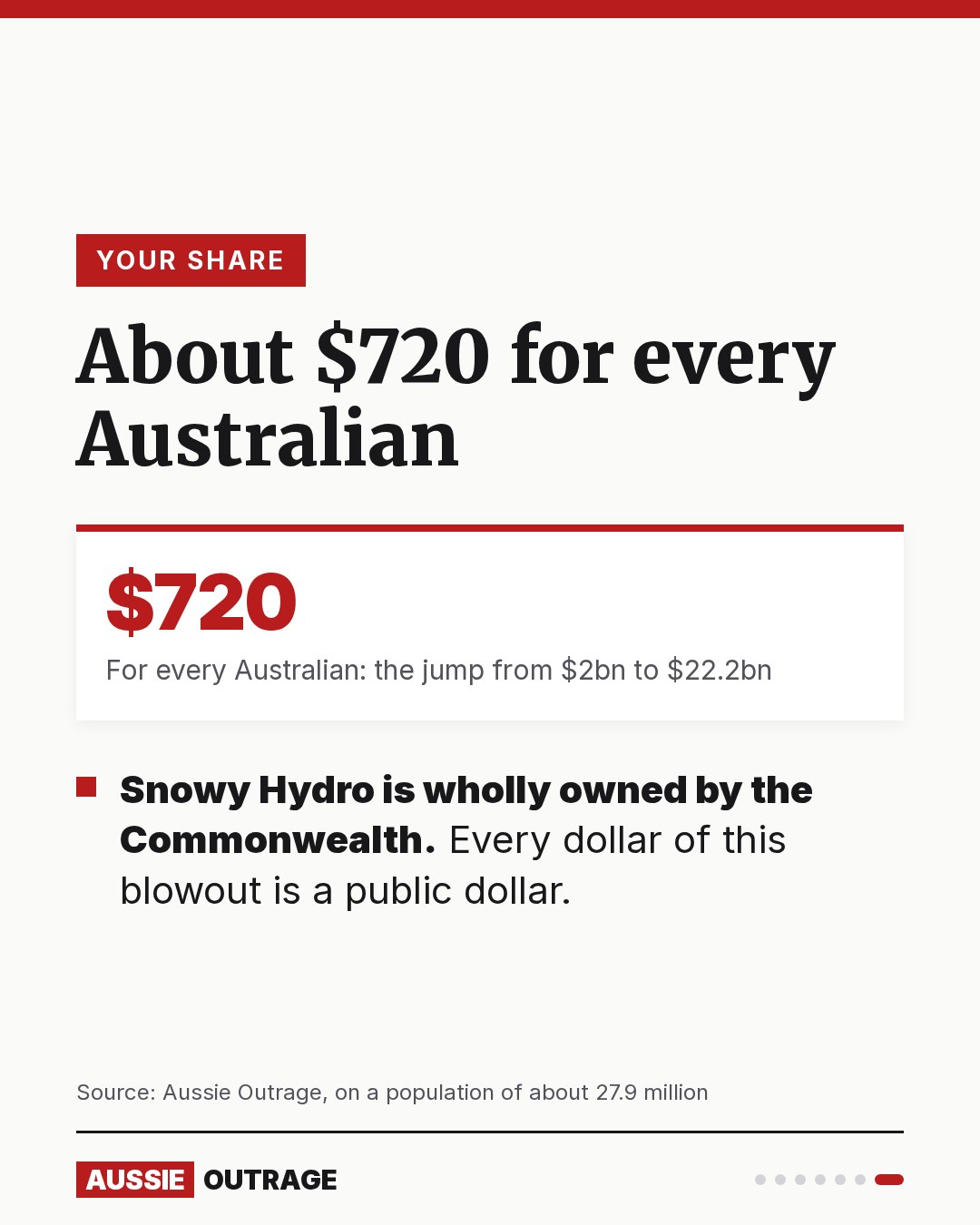
But Snowy Hydro is wholly owned by the Commonwealth. The loans it repays come out of the earnings of a company the public owns.
What you're getting for it
When finished, Snowy 2.0 will link the Tantangara and Talbingo reservoirs through 27 kilometres of tunnels to a power station 800 metres underground, with 2,200 megawatts of capacity. Snowy Hydro says it could power three million homes for a week. ANU energy researcher Andrew Blakers says that when it's finished it will provide "more than 80 per cent of all the energy storage in Australia all by itself". A GHD study estimates more than $7 billion in lower wholesale electricity costs by 2075.
Those benefits may be real. But Australians were told they would get them for $2 billion in 2021, not up to $25 billion in 2029.
Who's to blame?
Energy Minister Chris Bowen and Finance Minister Katy Gallagher say walking away would scrap 5,000 jobs, and that "the former Coalition government left behind a project facing major delays, rising costs and serious delivery risks". Shadow Energy Minister Dan Tehan says "Chris Bowen should apologise to the Australian taxpayer and resign".
Both sides have had their hands on Snowy 2.0. Both sides signed off on the money. And Snowy Hydro's chief executive is making no promises about the new figure: "There's never any guarantees with mega projects," he said.
Your share: the jump from $2 billion to $22.2 billion works out to about $720 for every Australian (on a population of about 27.9 million). For scale, this year's interest bill on the national debt, $27.7 billion, is more than Snowy 2.0's entire target cost: see the debt clock.
Questions people ask
How much will Snowy 2.0 cost?
Snowy Hydro's target cost is $22.2 billion, with an allowance for a cost scenario of $25 billion, after its October 2026 reassessment. Snowy 2.0 was announced in March 2017 at about $2 billion.
How much has been spent on Snowy 2.0?
$11.1 billion had been spent on Snowy 2.0 by 31 March 2026, according to the Australian National Audit Office.
Why is Snowy 2.0 so expensive?
Snowy Hydro blames a design that was immature when the investment decision was made, construction complexity that saw its main contractor miss productivity targets, the contractor underestimating the job, and global cost escalation. The ANAO found Snowy Hydro's management of the project since the 2023 reset was only "partly effective".
When will Snowy 2.0 be finished?
Snowy Hydro expects first power in early 2029 and has set a target completion date of late 2029. When Snowy 2.0 was announced in 2017, power was promised by 2021.
Who is paying for Snowy 2.0?
Snowy Hydro, which is wholly owned by the Commonwealth. At the previous $12 billion estimate, about $4 billion was Commonwealth investment it didn't have to repay, and most of the rest came from government and bank loans it must repay with interest, plus its own cash flows. How the higher cost will be funded hadn't been settled as of October 2026.
Who is building Snowy 2.0?
The main contractor is the Future Generation Joint Venture, made up of Webuild, Clough and Lane, working for Snowy Hydro.
Is Snowy 2.0 going ahead?
Yes. Energy Minister Chris Bowen and Finance Minister Katy Gallagher say walking away would scrap 5,000 jobs, and called it "an incredible national asset" once completed. In October 2026 Snowy Hydro said its drill-and-blast tunnels were 95% complete and its machine-bored tunnels 65%.
Snowy Hydro is wholly owned by the Commonwealth. Whether it's paid for with taxpayer equity, loans Snowy must repay, or Snowy's own earnings, the money is public.
Sources
- Snowy Hydro: Snowy 2.0 cost reassessment complete (22 Oct 2026) (opens in a new tab)
- 2026-27 Budget Paper 1, Statement 7: Debt Statement (interest on government securities) (opens in a new tab)
- ABC News: Review finds delayed Snowy 2.0 hydropower project could cost up to $25b (22 Oct 2026) (opens in a new tab)
- ABC News: Billions over budget and years late: How Snowy 2.0 got here (3 Jun 2026) (opens in a new tab)
- Australian National Audit Office: Delivery of Snowy 2.0, Auditor-General Report No. 39 of 2025-26 (18 Jun 2026) (opens in a new tab)
- ABC News: Auditors say Snowy 2.0 not holding contractors accountable (18 Jun 2026) (opens in a new tab)
- Construction Briefing: Snowy 2.0 cost blowout could hit A$25bn (23 Oct 2026) (opens in a new tab)
- RenewEconomy: Critics predict fresh Snowy 2.0 cost blowouts (on the Woodley and Mountain estimate) (opens in a new tab)
Spotted an error, or named in this story and want to respond? Tell us. We correct mistakes openly, under our editorial standards.
Got a story we should tell?
Waste you've seen up close, a policy that's hurting your family, a cost you can't keep up with. We read every tip and protect our sources.
Send us a tipMore in Government Waste
Suburban Rail Loop cost: $50bn promised, $96.4bn forecast
How much will the Suburban Rail Loop cost? $33.3bn for stage one, says the government, but the Auditor-General says it could top $36bn. Two stages: $96.4bn.
Aussie Outrage · · 12 min read

$1.6 million on pot plants for Big Build offices
Rail Projects Victoria spent an estimated $1.64 million on plant hire and maintenance, and the Suburban Rail Loop Authority almost $200,000 more, according to the state opposition.
Aussie Outrage · · 2 min read
$589 million to host nothing: what cancelling the Commonwealth Games cost Victoria
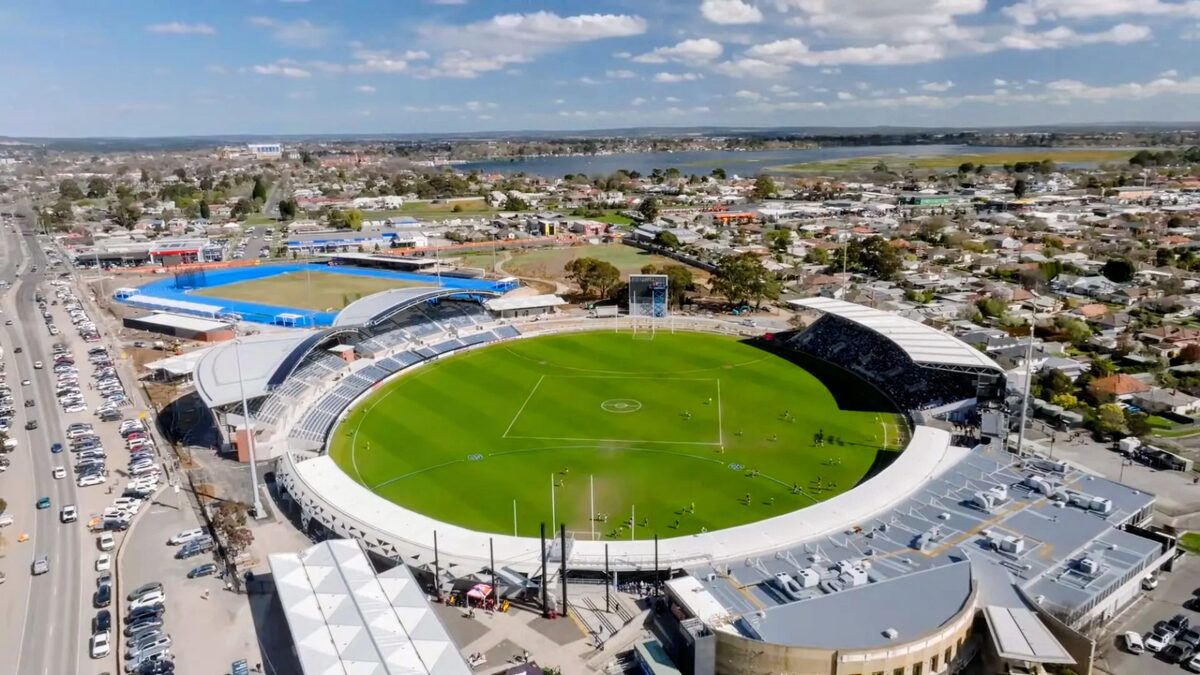
Victoria pulled out of the 2026 Commonwealth Games to save money. The Auditor-General found walking away cost $589 million with no discernible benefit, and the $6.9 billion figure used to justify it was overstated.
Aussie Outrage · · 2 min read
The $13 million machete ban: what the money actually pays for
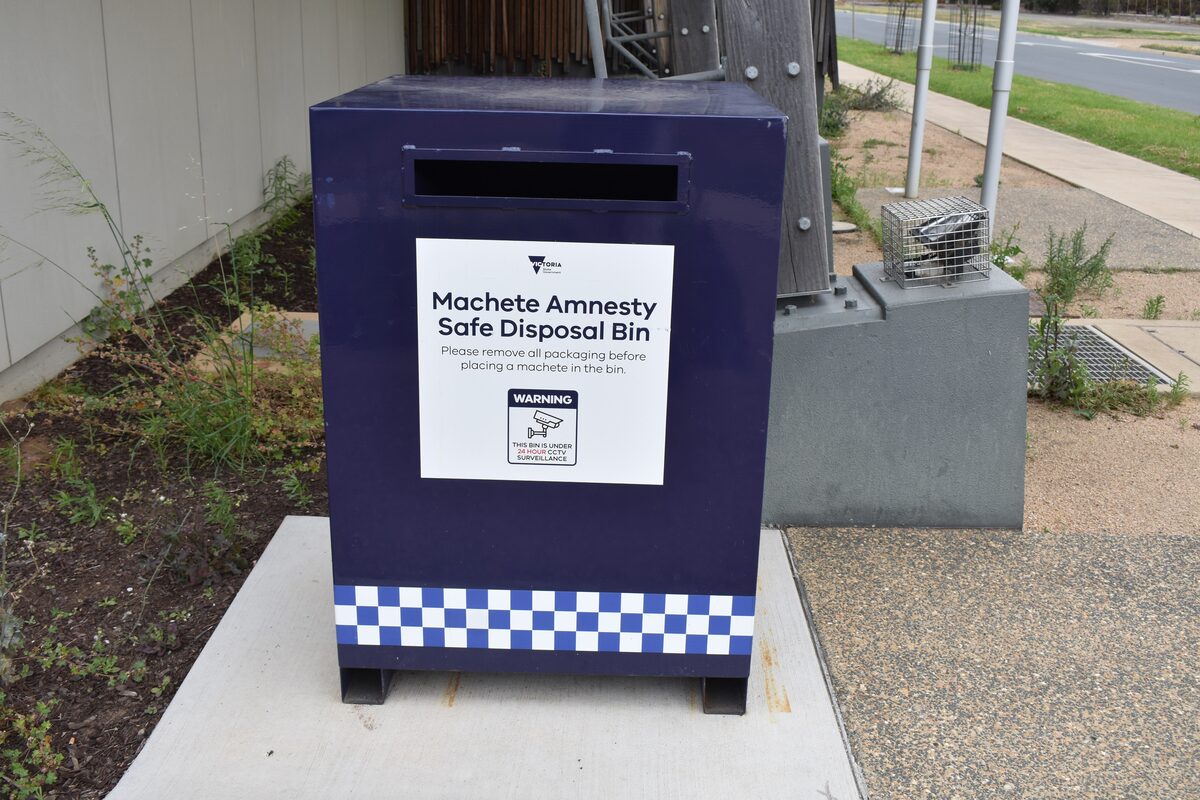
Victoria set aside $13 million for its machete ban and amnesty bins. The bins cost about $2,400 each. The government still hasn't said where the rest of the money goes.
Aussie Outrage · · 2 min read