4x
Inland Rail's latest full cost compared with its 2015 business case
Inland Rail was sold as a $10.7 billion project. It now costs $45.6 billion, and stops at Parkes
Inland Rail's full cost is now $45.6bn, four times the 2015 business case. In May the government stopped it at Parkes, 1,000km short of Brisbane.
Aussie Outrage · · 6 min read
Inland Rail was meant to be a 1,600-kilometre freight line from Melbourne to Brisbane, moving freight between the two cities in under 24 hours. The 2015 business case put the cost at $9.9 billion, or $10.7 billion on its more cautious (P90) estimate. Construction was to run from 2016 to 2025, Infrastructure Australia's evaluation said.
In November 2025, an independent review by consultants ACIL Allen put the cost of finishing the full line at $45.6 billion, with construction not finished until late 2035. The infrastructure department's secretary, Jim Betts, told Senate Estimates that "the $45.6 billion is the lower-end estimate".
In May 2026, the government stopped funding the line north of Parkes in central NSW. The line will run from Beveridge, north of Melbourne, to Parkes by the end of 2027. North of there, the corridor will be protected but not built.
$45.6bn
The price tag, year by year
Inland Rail's price tag has more than quadrupled
Estimated cost of the full Melbourne to Brisbane line, billions of dollars
2015 and 2025 are both P90 (cautious) estimates in nominal dollars. In 2015 the P50 estimate was $9.9bn. The 2025 figure assumed work would start in mid-2025, which didn't happen.
Source: Infrastructure Australia (2016); Schott review (2023); ACIL Allen (Nov 2025)
Show the data
| Date | Value |
|---|---|
| Aug 2015 | $10.7bn |
| Jun 2020 | $16.4bn |
| Apr 2023 | $31.4bn |
| Nov 2025 | $45.6bn |
| When | Estimated cost | Promised completion |
|---|---|---|
| 2015 (business case) | $9.9bn (P50) to $10.7bn (P90) | 2025 |
| 2020 | $16.4bn | |
| April 2023 (Schott review) | $31.4bn | Early 2030s |
| November 2025 (ACIL Allen) | $45.6bn | Construction to November 2035 |
| May 2026 | Line stops at Parkes | Beveridge to Parkes by end of 2027 |
And the business case wasn't the first number. A 2021 Senate committee report, Inland Rail: derailed from the start, said the original estimate was $4.7 billion, from an ARTC study in 2010.
What went wrong
Building before knowing where it would start or finish. Dr Kerry Schott's 2023 independent review found that work had begun "somewhat surprisingly" without settled start and end points, and that "there is insufficient certainty about the scope, the related schedule, and delivery costs". She said the cost estimate of the time "should not be accepted by the shareholder", meaning the government.
The wrong people in charge. Schott found that "appointments to the board did not provide the skills required", and pointed to weaknesses in governance, risk management and project management at the Australian Rail Track Corporation (ARTC), the government company building the line. The government agreed to her 19 recommendations, and a new company, Inland Rail Pty Ltd, took over the project in May 2024.
Queensland was never sorted out. The sections still to be built in northern NSW and Queensland are mostly new track on new land. Betts told Senate Estimates the biggest sticking points were Queensland planning approvals still to come, along with land acquisition, environmental consent and "unexpected technical matters".
Even the new estimate was optimistic. ACIL Allen found Inland Rail's costing methods were "fit for purpose and consistent with industry best practice". But the $45.6 billion assumed work would start from 30 June 2025. It didn't, and ACIL Allen warned that this "is likely to result in an increase in the estimated cost".
What you're getting for it
The southern half is real and nearly done. Once Beveridge to Parkes is finished at the end of 2027, double-stacked freight trains will be able to run from Melbourne to Perth through Parkes, with a new 39-kilometre line bypassing the winding Bethungra Spiral. The Parkes to Narromine section and the first stage of Narromine to North Star are already finished.
The government says the priority now is the existing interstate freight network, which has been shut by weather for about 200 days in the past five years. "What industry have said to us is that the priority is to invest in the integrity of the existing network," Betts said. The government is reallocating $1.75 billion in previously announced funding and putting $55 million into an incentive scheme to move more freight by rail and sea.
What Australians won't get, for now, is the thing they were sold: a freight line to Brisbane.
Who's to blame?
Both sides have owned this project. Labor and the Coalition both took $300 million pledges for Inland Rail to the 2013 election. The Turnbull government put $8.4 billion into the ARTC to build it in 2017, and construction started under the Coalition in 2018.
Infrastructure Minister Catherine King says "the 2023 independent review found major deficiencies in the governance and delivery of Inland Rail" under the former government, and that "we are taking sensible decisions to realign the future of Inland Rail".
Shadow Infrastructure Minister Bridget McKenzie says "history will record that this Labor Government pulled up the tracks half-way without any warning", and that "this decision means no long-term project is safe". NSW Farmers president Xavier Martin said: "We need the Minister to tell us what this means north of Parkes."
Your share: the jump from $10.7 billion to $45.6 billion works out to about $1,250 for every Australian (on a population of about 27.9 million). Most of that money hasn't been spent, and now may never be. But it's the price Australians would have to pay to finish what they were promised.
The ARTC and Inland Rail Pty Ltd are wholly owned by the Commonwealth, like Snowy Hydro, whose Snowy 2.0 went from $2 billion to a $22.2 billion target.
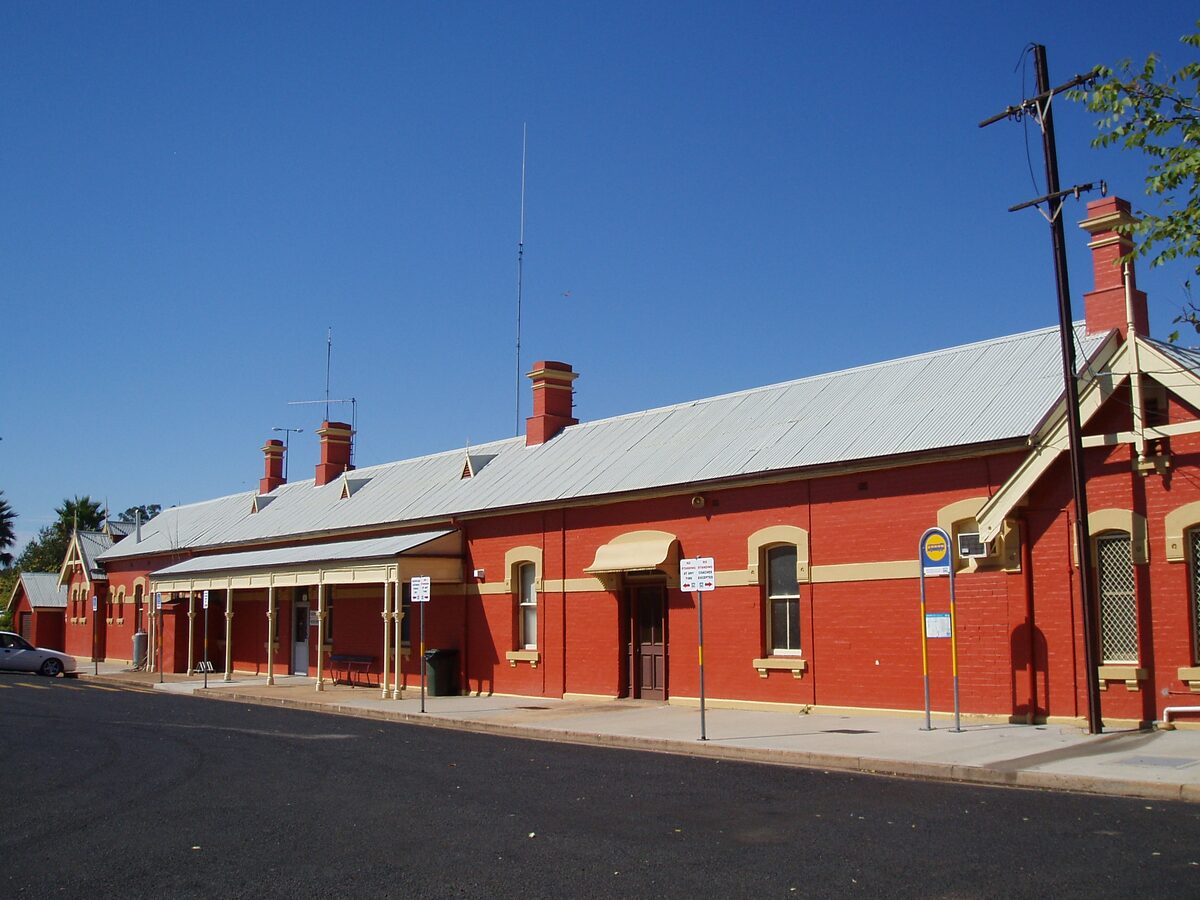
Top photo: Parkes railway station in central NSW (file photo, 2009). Photo: Amanda Slater, CC BY-SA 2.0, via Wikimedia Commons.
Sources
- ACIL Allen: Verification and assurance of Inland Rail scope, design, delivery and cost, Summary (20 Nov 2025) (opens in a new tab)
- Infrastructure Australia: Inland Rail project business case evaluation summary (May 2016) (opens in a new tab)
- Minister for Infrastructure Catherine King: Record investment in the freight rail network and consolidating Inland Rail (May 2026) (opens in a new tab)
- ABC News: Albanese government axes funding for $45 billion Inland Rail project (5 May 2026) (opens in a new tab)
- Grain Central: Inland Rail halted north of Parkes as $45B cost revealed (6 May 2026) (opens in a new tab)
- InDaily (AAP): 'Flying blind': Why Labor ditched the inland rail route (25 May 2026) (opens in a new tab)
- Canberra Times: Inland Rail project dogged by failure as cost blows out (on the 2023 Schott review) (opens in a new tab)
Spotted an error, or named in this story and want to respond? Tell us. We correct mistakes openly, under our editorial standards.
Got a story we should tell?
Waste you've seen up close, a policy that's hurting your family, a cost you can't keep up with. We read every tip and protect our sources.
Send us a tipMore in Government Waste
Suburban Rail Loop cost: $50bn promised, $96.4bn forecast
How much will the Suburban Rail Loop cost? $33.3bn for stage one, says the government, but the Auditor-General says it could top $36bn. Two stages: $96.4bn.
Aussie Outrage · · 12 min read
$1.6 million on pot plants for Big Build offices
Rail Projects Victoria spent an estimated $1.64 million on plant hire and maintenance, and the Suburban Rail Loop Authority almost $200,000 more, according to the state opposition.
Aussie Outrage · · 2 min read
$589 million to host nothing: what cancelling the Commonwealth Games cost Victoria
Victoria pulled out of the 2026 Commonwealth Games to save money. The Auditor-General found walking away cost $589 million with no discernible benefit, and the $6.9 billion figure used to justify it was overstated.
Aussie Outrage · · 2 min read

The $13 million machete ban: what the money actually pays for
Victoria set aside $13 million for its machete ban and amnesty bins. The bins cost about $2,400 each. The government still hasn't said where the rest of the money goes.
Aussie Outrage · · 2 min read