75%
Share of east coast gas production that is exported as LNG
Three-quarters of east coast gas is shipped overseas. Australians pay export prices for the rest
Before the Gladstone LNG plants opened, east coast gas cost about $4 a gigajoule. Now it's around $14, and the regulator is warning of shortfalls. Follow the gas, and the money.
Aussie Outrage · · 6 min read
Australia is one of the three biggest gas exporters on earth, alongside Qatar and the United States. Yet the competition regulator spent this winter warning that the east coast could run short, and in Victoria, where homes and small businesses use 60% of the state's gas, families pay prices that the energy regulator says are "influenced by international gas prices".
Here's where the gas goes.
75%
Where east coast gas goes
Share of gas produced in eastern Australia (excluding the NT)
- Exported as LNG75%
- Sold to Australian homes, businesses and power stations25%
Source: AER, State of the energy market 2025
Show the data
| Part | Share |
|---|---|
| Exported as LNG | 75% |
| Sold to Australian homes, businesses and power stations | 25% |
Follow the gas
| Step | What happens |
|---|---|
| 1 | Gas is pumped from coal seams in Queensland's Surat and Bowen basins |
| 2 | Pipelines carry it to three export plants on Curtis Island, near Gladstone |
| 3 | It is chilled into liquid (LNG) and loaded onto ships. East coast exports topped 1,300 petajoules for the first time in 2024 |
| 4 | Most of it goes to Asia. China took 60% of eastern Australia's LNG in 2024 |
| 5 | What's left, about a quarter, is sold to Australian homes, factories and power stations |
In 2024, LNG exporters used more gas than every Australian household, business, factory and gas power station on the east coast put together.
Then the price tripled
Before the Gladstone plants opened in 2015, east coast gas had been sold for decades at around $3 to $4 a gigajoule, according to the ACCC. Once producers could ship gas overseas, they could choose who to sell it to, and Australians started paying close to what Asian buyers pay.
What Australians pay for their own gas
Typical east coast wholesale gas price, dollars per gigajoule
Before exports began (pre-2015)
$3 to $4Early 2017 (peak of the first crunch)
Up to $20'Reasonable price' under the gas code (since July 2023)
$12Producer contracts, second half of 2024
$13.58
Source: ACCC (long-run price before exports, and 2017 peak); AER, State of the energy market 2025 (2024 contract price)
Show the data
| Item | Value |
|---|---|
| Before exports began (pre-2015) | $3 to $4 |
| Early 2017 (peak of the first crunch) | Up to $20 |
| 'Reasonable price' under the gas code (since July 2023) | $12 |
| Producer contracts, second half of 2024 | $13.58 |
Spot market prices in the second half of 2024 averaged just over $13 too.
After an emergency price cap in December 2022, a mandatory code has since July 2023 set a "reasonable price" of $12 a gigajoule for most gas sold by producers on the east coast, with exemptions. That's still three times what Australians used to pay.
Follow the money
LNG brought in an estimated $72 billion in export revenue in 2024-25.
The federal government's special tax on gas profits, the petroleum resource rent tax (PRRT), collected $1.42 billion. Queensland collected another $1.69 billion in petroleum royalties.
$72bn vs $1.4bn
The PRRT isn't the whole tax bill. Oil and gas companies also pay ordinary company tax: $10.6 billion in 2024-25, the sector's second-highest on record, according to the ATO. But the PRRT is the tax meant to give Australians a share of the windfall from selling a resource they own, and expected receipts keep being revised down: by $2.5 billion over the four years to 2027-28 at the last mid-year update.
What the gas earned, and the taxes on it
2024-25, billions of dollars
LNG export revenue (all Australia)
$72bnCompany tax paid by oil and gas companies
$10.6bnQueensland petroleum royalties
$1.69bnPetroleum resource rent tax (PRRT)
$1.42bn
Company tax covers all oil and gas companies nationally, not only east coast LNG. These are different taxes and shouldn't be added up as one bill.
Source: AER (export revenue forecast); The Conversation, Kevin Morrison (PRRT, royalties); ATO via ABC News (company tax)
Show the data
| Item | Value |
|---|---|
| LNG export revenue (all Australia) | $72bn |
| Company tax paid by oil and gas companies | $10.6bn |
| Queensland petroleum royalties | $1.69bn |
| Petroleum resource rent tax (PRRT) | $1.42bn |
"If they export all their uncontracted gas"
The ACCC's latest outlook says the east coast should have enough gas for the rest of 2026. But it warns of possible shortfalls in the autumn and winter of 2027, "if LNG producers export all their uncontracted gas".
The pressure falls hardest on the south. In Victoria, 60% of gas is used by homes and small businesses, mostly for heating and cooking, and the old Bass Strait fields are running down. Southern states now rely on gas piped down from Queensland, past the export terminals, and on gas stored over summer.
The fix that starts in 2027
On 14 October 2026, the government introduced legislation for a national Domestic Gas Reservation. LNG exporters will have to supply Australian customers with the equivalent of 20% of their exports, "calibrated to forecast domestic demand", in exchange for the right to export. When the scheme was announced, the government said it would start on 1 July 2027.
"For too long Australians have watched our gas leave our shores while local households and businesses faced uncertainty and rising costs," Energy Minister Chris Bowen said.
But existing export contracts are respected. Law firm Allens says contracts signed before 22 December 2025 are excluded, which will mute the scheme's effect, and Santos's Gladstone LNG contract with Korea Gas Corporation is protected until 2031.
The other side
Gas companies argue the Queensland coal seam gas fields would never have been developed without the long-term export contracts that paid for them, and that the gas sold to Australians today exists because of that investment. The industry points to the jobs, the company tax and the royalties it pays, and says the answer to high prices is approving more supply, not interfering in contracts.
Shell Australia chair Cecile Wake called the reservation bill a "sledgehammer to crack a nut" and an "extraordinarily heavy-handed intervention into a market that is actually working well", warning it could push prices below the cost of bringing new gas fields into production.
Those are real arguments. But Australians were never asked whether they wanted to pay export prices for their own gas, and a decade on, they still are.
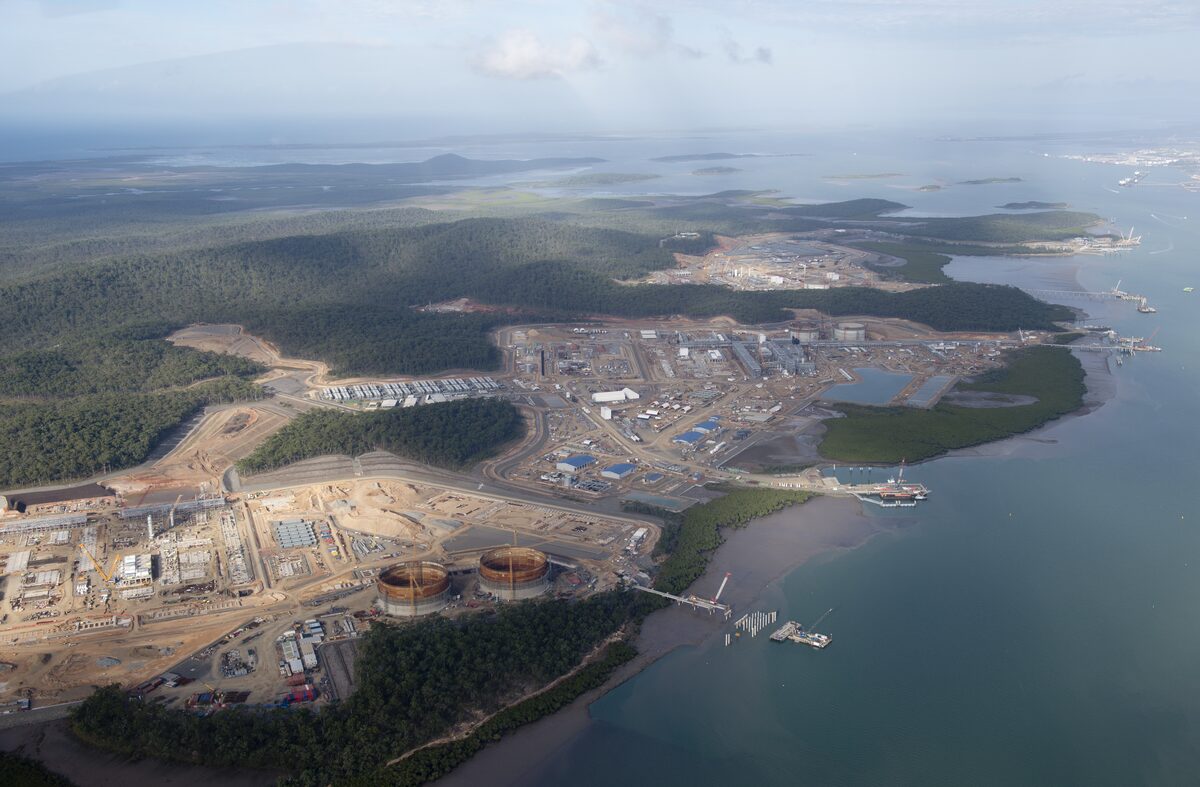
Top photo: LNG plants under construction on Curtis Island, near Gladstone, June 2013. Photo: Lock the Gate Alliance, CC BY 2.0, via Wikimedia Commons.
Sources
- AER: State of the energy market 2025, Chapter 4: Gas markets in eastern Australia (opens in a new tab)
- ACCC: East coast gas market to be well supplied in Q4 2026 but more investment needed (10 Jul 2026) (opens in a new tab)
- The Conversation: Australia isn't getting a fair share of tax on gas exports (30 Apr 2026) (opens in a new tab)
- Allens: Australia's gas reservation scheme (May 2026) (opens in a new tab)
- ACCC: East coast gas inquiry 2015 report (opens in a new tab)
- Ministers Bowen, King and Ayres: Landmark legislation to secure Australian gas for industry and households (14 Oct 2026) (opens in a new tab)
- Energy Source & Distribution: Australian Govt introduces Domestic Gas Reservation bill (15 Oct 2026) (opens in a new tab)
- ABC News: ATO says 1,149 large companies paid no tax (1 Oct 2026) (opens in a new tab)
Spotted an error, or named in this story and want to respond? Tell us. We correct mistakes openly, under our editorial standards.
Got a story we should tell?
Waste you've seen up close, a policy that's hurting your family, a cost you can't keep up with. We read every tip and protect our sources.
Send us a tipMore in Follow the Money

1,149 of Australia's biggest companies paid no income tax last year
The ATO's latest tax transparency report covers every company earning more than $100 million. More than one in four paid nothing. Here's what the numbers show, and why the tax office says it's not always a scandal.
Aussie Outrage · · 7 min read

How to move a profit offshore: the 9% loan and the Singapore hub
Two real cases, one decided in court and one settled with the tax office for about $1 billion, show how multinationals can shrink an Australian tax bill. Follow the money, step by step.
Aussie Outrage · · 5 min read